
SENIOR CARE FRANCHISE OPPORTUNITIES
Senior Care Franchises:
The Business Opportunity of Our Generation
A complete guide to the four categories of senior care franchises and why the silver tsunami is the opportunity of our generation.
PURPOSE-DRIVEN · RECESSION-RESISTANT · GENERATIONAL DEMAND
I've Seen It. Now I'm Living It.
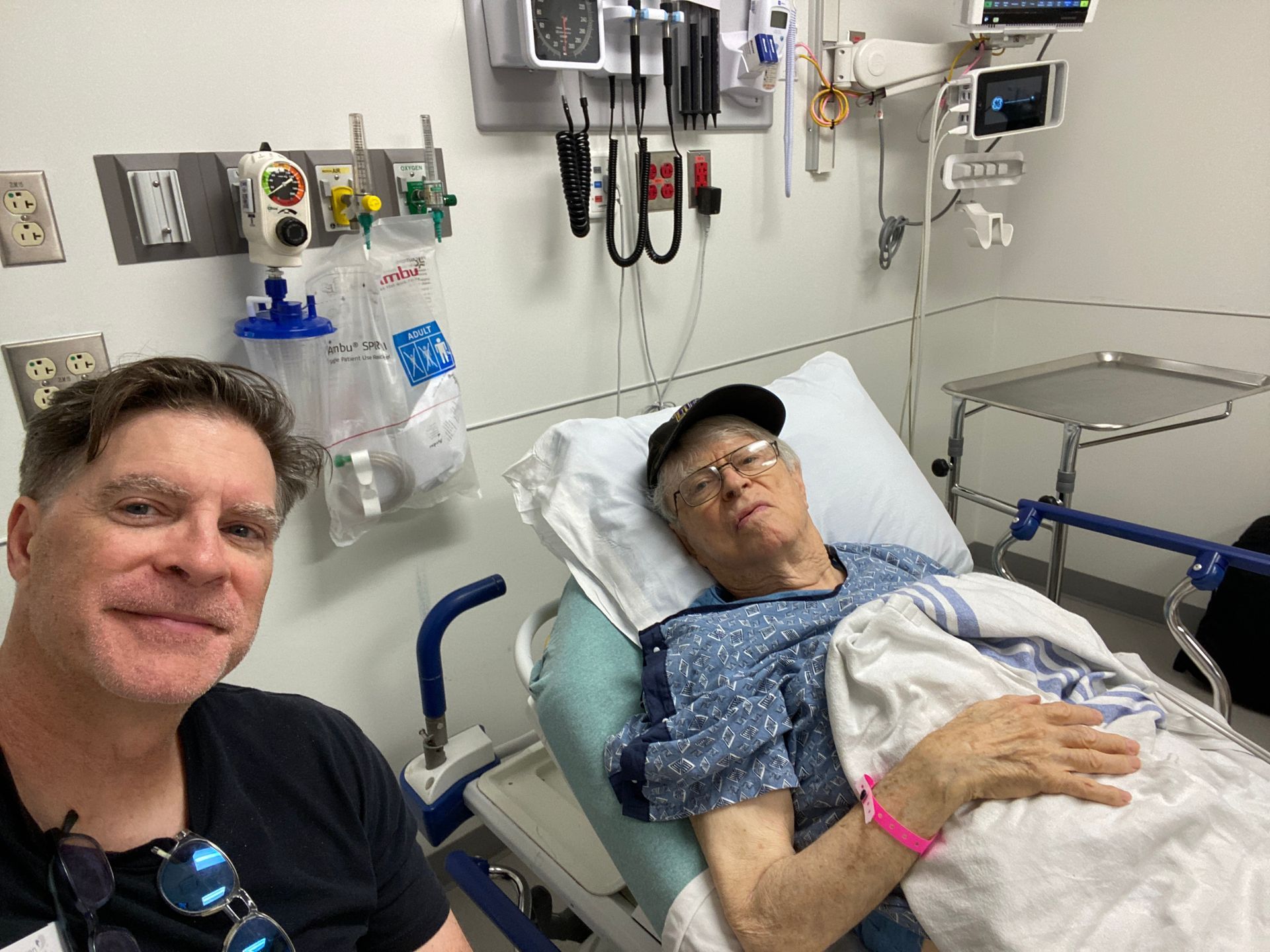
That photo was taken on one of many hospital visits I've made with my dad over the past few years. He's turning 89 this August. I don't share it to make a point. I share it because if you're reading this page, there's a good chance you have a photo just like it on your own phone.
I've been watching this road my whole life. As a kid, I watched my parents navigate my grandparents' care. First the sitters, then the hard conversation about assisted living. I never forgot how hard that was on our family. Now it's my turn.
My mom is 84. I take them both to their doctor appointments, I answer the phone calls, and I carry that quiet awareness every adult child of aging parents knows: that the next call could come at any hour.
They call it the sandwich generation. You're managing your own life while catching someone else's. It's not easy. But it has given me something I couldn't have manufactured: I understand what families going through this actually need.
It shows up in unexpected places. I have two elderly neighbors — one is 90 and one is 88. The 90-year-old just lost her husband after 65 years of marriage. Something as simple as taking out her garbage means the world to her. My other neighbor just needs a ride to PT sometimes, or to the doctor. I'm there when I can be. It's not a business transaction. It's just what you do when you understand the need.
That understanding is exactly why I believe senior care franchises represent one of the most compelling business opportunities available today, and why I've built a curated portfolio of the best brands across every segment of this space.
The Silver Tsunami Is Not Coming. It's Already Here.
The numbers are impossible to ignore.
every single day
age at home
care market by 2029
Every single day, more than 10,000 Americans turn 65. By 2030, one in five people in every U.S. state will be 65 or older. The 80-plus population is projected to grow by 50 percent over the next decade alone. By 2056, that daily figure climbs to 13,000 people turning 65, every day.
The industry has a nickname for what's happening. They call it the silver tsunami. It's been building for years, and it is only just beginning to break.
An overwhelming 90 percent of seniors want to remain in their own homes as they age. Home-based care costs families significantly less than assisted living or nursing home placement. The preference is clear. The demand is growing. And the workforce to meet it has not kept pace.
That gap, between what seniors need and what currently exists to serve them, is where the opportunity lives. The U.S. elderly care services market is on track to grow from $455 billion today to over $651 billion by 2029. Franchised senior care locations have grown at a steady five percent annually to nearly 8,000 units nationwide. Private equity has taken notice. Family offices have taken notice. And candidates I speak with every week are taking notice.
For the right person — someone with patience, purpose, and a genuine heart for this work — there has never been a better time to build something in this space.
You Don't Need a Healthcare Background.
You Need the Right Foundation.
One of the most common misconceptions I hear from candidates is that you need clinical experience to succeed in senior care. You don't.
What you need is a commitment to doing it right, the humility to follow a proven system, and the emotional intelligence to lead a team that serves vulnerable people with dignity. The best franchisors in this space have spent years building the training, the operational playbooks, and the support infrastructure so that qualified owners — not just healthcare professionals — can run thriving businesses.
This is also one of the more accessible categories from an investment standpoint. Many strong brands can be launched for well under $200,000. Some placement and advisory concepts require significantly less. That combination — lower barrier to entry, recession-resistant demand, and genuine human impact — is rare. It's why I keep coming back to this space in conversations with candidates.
You have to have a heart for it. The seniors you serve will feel whether you do or you don't. In my experience, when you show up for people who genuinely need help, the gratitude you receive is unlike anything else in business.
That matters. It keeps franchisees in this space for the long term in a way that pure economics never could.
Four Categories. One Complete Opportunity.
What most articles about senior care franchises miss is that this is not a single category. It is an ecosystem — four distinct types of businesses that serve seniors at different points along the care journey. Understanding the difference is the first step to finding the right fit for you.
In-Home Personal Care
Caregivers come to the senior's home. Daily living, companionship, medication support, personal care. The largest and most established segment of the market — and the most direct expression of the aging-in-place preference.
They are also the only home care brand with client and caregiver lead generation programs through national agreements with A Place For Mom and Indeed — a built-in pipeline from day one. Average gross revenue for franchisees open five or more years is over $1.6 million.
More than 40 percent of their franchisees own multiple units, which speaks to the scalability and confidence owners have in the model. Comfort Keepers offers multiple revenue streams including companionship, personal care, private duty nursing, and technology-enabled care. Three weeks of intensive new franchisee training and a dedicated support specialist are included.
Average gross billings climb from $562,578 at 12 months to over $1.2 million at 36 months, with an overall system average of $1.6 million. Funding assistance available including SBA loans and business-directed retirement programs. Named to the 2025 Entrepreneur Franchise 500.
That clinical infrastructure opens doors other brands cannot access — including skilled medical care, medical staffing revenue, and national account contracts with over 180 healthcare organizations. Over 93.2% of clients rate their experience a 4 or above on a 5-point scale. Ranked on the Entrepreneur Franchise 500 for 16 consecutive years.
Senior Placement & Advisory
Matching families to the right care setting — assisted living, memory care, independent living, skilled nursing. Home-based, low-overhead, high-trust. No caregivers to hire. Your value is your expertise and your relationships.
What makes CarePatrol particularly powerful is its national infrastructure: national contracts with 15 of the 20 largest senior living communities in the country give franchisees immediate access to higher placement commissions and a built-in referral network from day one. They are also the only franchise in this space using Medicare Analytics to identify and reach families before competitors do.
Perhaps most telling: 58 percent of franchisees had their highest-producing year in 2020 — during the height of the COVID-19 crisis. That is as strong a proof of recession resilience as exists in franchising. Territories are customized, exclusive, and large. Full in-house marketing team included.
The financial model is compelling: assisted living placements generate an average monthly rate of $4,600, while Alzheimer's and memory care placements average $6,500 per month, with franchisee commissions running 85 to 100 percent of placement fees. Home-based, state-of-the-art proprietary CRM, robust national contracts.
The results: one represented franchisee in Louisville reported $2,474,018 in gross sales in 2025, with an average monthly revenue per client of $6,001. Hallmark is the only homecare referral agency offering franchise opportunities — no direct franchise competition exists in this model.
Senior Home Safety & Accessibility
The category almost no one is talking about — and possibly the most underleveraged opportunity in the entire senior care space. While thousands of companies care for the senior as a person, almost no one is caring for the home itself. That's the gap this category fills.
Their franchisees conduct Senior Home Safety Assessments, backed by a third-party Home Safety Specialist Certification, then handle the modifications, repairs, and quarterly maintenance that keeps seniors safe. Three revenue streams flow through the same business: senior safety services, on-demand handyman services, and recurring home maintenance plans. TruBlue has formal preferred-partner relationships with Comfort Keepers, Home Instead, and Right at Home — making it a natural companion to any Category 1 franchise in the same territory.
Their core product is a proprietary steel modular wheelchair ramp manufactured in-house at their Randolph, Massachusetts headquarters — a quality and customization advantage competitors can't match. Beyond ramps, franchisees sell and rent stairlifts, platform lifts, grab bars, portable showers, overhead patient lifts, and automatic door openers. 4.9-star aggregate customer rating across 1,500+ reviews. Their non-profit arm, AmrampCARES, provides ramps to families at or below the poverty line.
The $43,000 average referral fee is a standout data point in this category. The customer base is growing rapidly as the senior population expands. Small employee footprint, strong corporate infrastructure, and national account relationships that drive leads directly to franchisees.
Adult Day Enrichment Centers
A built facility where seniors come during the day for programming, socialization, and memory care activities. Families drop loved ones off in the morning. They pick them up in the evening. The senior has a vibrant, structured day. The family gets the relief they desperately need.
Town Square provides crucial care services at roughly half the cost of home care, opening an affordable option to a much broader market. Revenue streams include private pay, with Medicaid and VA benefits possible. The concept has been covered by AARP, NPR, PBS, ABC Nightline, the Today Show, and the Wall Street Journal. First-mover advantage is real — territory availability is strong.
The Smart Investor Play: Owning Across Categories
Some of the most successful operators in the senior care space don't own just one brand. They own a Category 1 in-home care franchise and a Category 3 home safety brand serving the same geography. The caregiver identifies the hazard. The home safety team fixes it. One client, two revenue streams — and a referral engine that runs in both directions. This is not theoretical. Established brands have built formal preferred-partner relationships specifically because franchisees figured out this dynamic and started doing it on their own.
Frequently Asked Questions.
Senior Care Is Not a Trend.
It's a Generational Obligation.
This space is moving. Territories open today may not be open in six months. If senior care has been on your radar — if you've watched a parent navigate this road, if you've felt the pull toward work that actually means something — now is the time to have the conversation.
I don't just match candidates with brands. I match candidates with the right brand for their goals, their market, and who they are as an operator.
Brands shown represent a selection from available inventory. Not all brands available in all markets. Territory availability varies. Financial performance figures referenced are from each brand's Franchise Disclosure Document and represent past performance of specific franchisees. Individual results will vary. This is not an offer to sell a franchise. Contact us for current territory availability and complete disclosure information.