February 22, 2026 by Ewell Smith
SMB stands for small and medium business. That's the clean answer, the one that shows up in textbooks and org charts.
It's also incomplete.
The definition tells you the size of the company. It doesn't tell you anything about what it's actually like to operate inside one, or to sell into one. And if you're in sales, those two things are everything.
What SMB Actually Stands For
SMB means small and medium business: companies that fall below enterprise scale, typically measured by headcount, revenue, or both. The U.S. Small Business Administration defines small businesses as those with fewer than 500 employees, though industry-specific thresholds vary. Medium businesses generally sit between 100 and 999 employees depending on the framework you're using.
You'll also see SME used interchangeably. SME stands for small and medium enterprise. Same concept, different acronym, more common outside the U.S.
SMBs make up the overwhelming majority of businesses in the U.S., over 99% by count, and they employ nearly half the private-sector workforce. The category is enormous. Which is part of why the label can mislead you.
Why the Definition Doesn't Tell the Whole Story
Two companies can both be SMBs and have almost nothing in common.
One runs lean, with documented systems, steady margins, and a leadership team that has been through a few cycles. The other is in its third year, running on momentum and a line of credit, making major decisions in the owner's kitchen. Same category. Completely different reality.
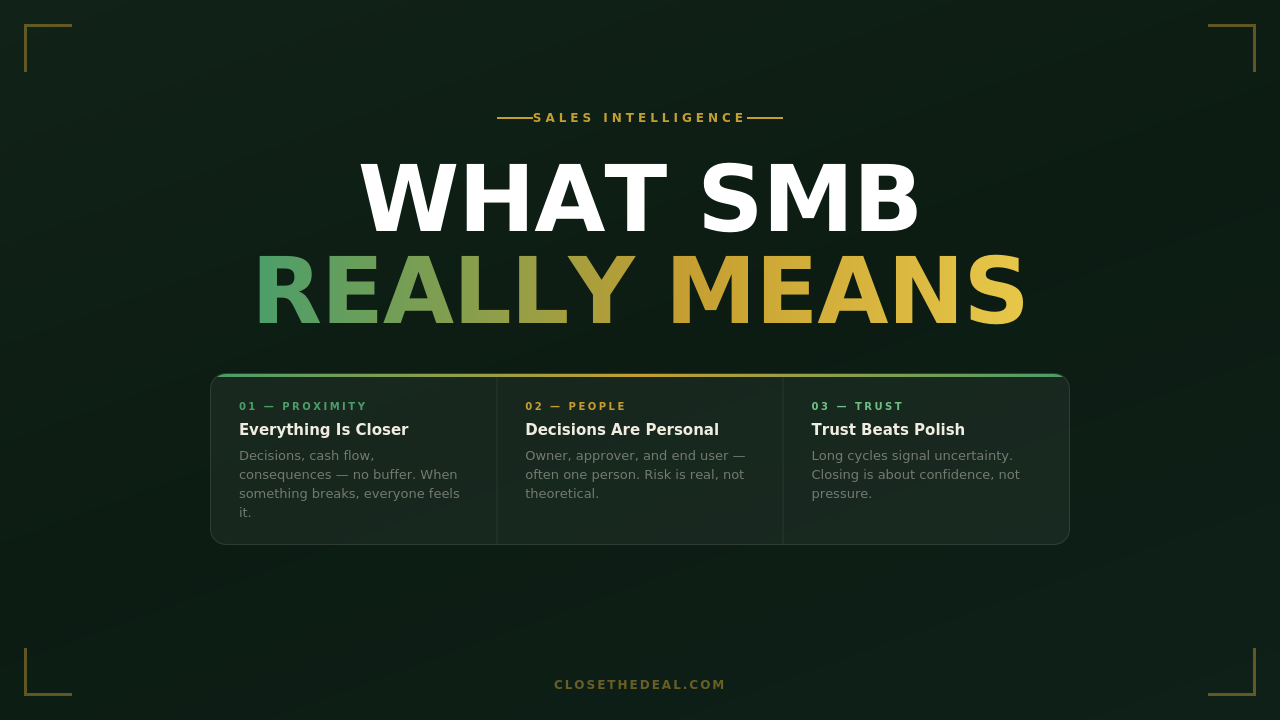
What SMBs actually share isn't size. It's proximity. Everything is closer. Decisions happen faster and with less process. Cash flow is felt, not just tracked. When something works, everyone notices. When something breaks, there's no department to absorb the damage.
That closeness changes how the business operates at every level.
How SMBs Actually Make Decisions
In an enterprise, a purchasing decision moves through procurement, legal, finance, and IT before it's signed. In an SMB, you're often talking to the person who will use the product, approve the budget, and feel the consequences. All in the same conversation.
That means decisions can happen fast. It also means they can stall for completely personal reasons that never show up in your CRM notes. An SMB owner who had a bad experience with a vendor two years ago doesn't need a committee to decide they're skeptical. They just are.
The people running SMBs are also playing a longer game than they let on. Growth is appealing. Stability is often the real objective, especially after someone has been burned. Payroll isn't abstract. Reputation is personal. When you understand that, you start to see why trust moves faster than polish in these conversations.
What Most People Get Wrong About Selling to SMBs
The most common mistake is treating SMBs like smaller versions of enterprise accounts.
Enterprise sales playbooks assume layers: champions, economic buyers, technical reviewers, procurement cycles. SMB sales often compress all of that into one or two people. Running the same multi-threaded approach on a 20-person company doesn't build consensus. It creates noise and signals that you don't understand their world.
A few things that actually move the needle in SMB sales:
Value has to be immediate and visible. SMB owners don't have the runway to wait six months for ROI. If they can't see how this helps them this quarter, the conversation stalls.
Long sales cycles usually mean uncertainty, not strategy. When an SMB goes quiet, it's rarely because they're running a careful evaluation. It's usually because something changed internally, or the pain isn't urgent enough yet.
Closing is less about pressure and more about confidence. The buyer needs to believe this won't blow up on them. Reduce perceived risk and you reduce hesitation.
SMB Sales as a Career Path
SMB sales gets underrated as a career track. It's high-volume, high-velocity, and it builds instincts faster than almost any other environment.
You're running more deals, having more conversations, and hitting more varied objections than someone in enterprise who might work one account for a year. The reps who excel in SMB develop pattern recognition quickly. They learn to qualify fast, read a room without structure, and close without a committee.
It's also one of the most direct paths to understanding what business ownership actually looks like. You spend your days talking to people who built something and are trying to protect it. That exposure is worth more than most MBA programs if you're paying attention.
SMB, Ownership, and What the Label Misses
For many people, SMBs aren't just where they work. They're what they're building toward. Buying a business, launching one, stepping into a franchise: these paths all live inside the SMB category.
The label SMB is technically accurate for all of them. What it doesn't capture is the weight of them. The owner who started with nothing and is now running a 12-person operation. The couple who bought a regional business and are figuring out the next chapter. The sales leader who got tired of building someone else's pipeline.
Those are all SMBs. None of them feel like a label.
The Bottom Line on SMB Meaning
SMB stands for small and medium business. The acronym is simple. The reality behind it isn't.
What actually defines the SMB experience is proximity: to decisions, to consequences, to customers, to cash. When things go right, everyone feels it. When things go wrong, there's nowhere to hide.
Understand that and you'll approach SMB sales differently. Not as a scaled-down version of something larger, but as its own environment with its own rules, one that rewards clarity, speed, and the kind of trust you actually have to earn.
Frequently Asked Questions About SMB
What does SMB stand for?
SMB stands for small and medium business. It refers to companies that fall below enterprise scale, typically defined by employee count or annual revenue. In the U.S., the Small Business Administration classifies small businesses as those with fewer than 500 employees, though thresholds vary by industry.
What is the difference between SMB and enterprise?
The core difference is structure and scale. Enterprises typically employ more than 1,000 people and have formal procurement processes with multiple decision-makers.
SMBs move faster and decisions often come down to one or two people, frequently the owner. The buying process, risk tolerance, and sales approach are fundamentally different between the two.
Title or Question
Describe the item or answer the question so that site visitors who are interested get more information. You can emphasize this text with bullets, italics or bold, and add links.What is the difference between SMB and SME?
SMB and SME mean the same thing. SMB stands for small and medium business; SME stands for small and medium enterprise. The difference is geography, not substance.
SMB is the preferred term in North America. SME is more common in Europe, the UK, and international business contexts.
What size is considered an SMB?
Small businesses are generally defined as companies with fewer than 100 employees and under $50 million in annual revenue.
Medium businesses typically fall between 100 and 999 employees. Definitions vary by industry and the SBA applies different thresholds across sectors.
What does SMB mean in sales?
In sales, SMB refers to the segment of companies below enterprise level that a team targets. Selling to SMBs is different from enterprise sales - cycles are shorter,
decision-makers are fewer, and the stakes are personal. Value needs to land immediately, trust matters more th
Is SMB a good market to sell into?
Yes, with the right approach. SMBs make up over 99% of U.S. businesses and nearly half the private-sector workforce. The market is enormous.
The key is understanding that SMBs are not scaled-down enterprises, they require faster qualification, clearer value, and a focus on confidence over complexity.
Subscribe



Laid off?
Not valued?
Ready to exit?
Discovered ageism
is real?
Be The Boss.
Close The Deal on
Your First Franchise
Claim Your Free Copy

About the Author Ewell Smith is the publisher of CloseTheDeal.com, host of the Close The Deal Podcast, and author of Your First Franchise Roadmap and Pink Slip Comeback